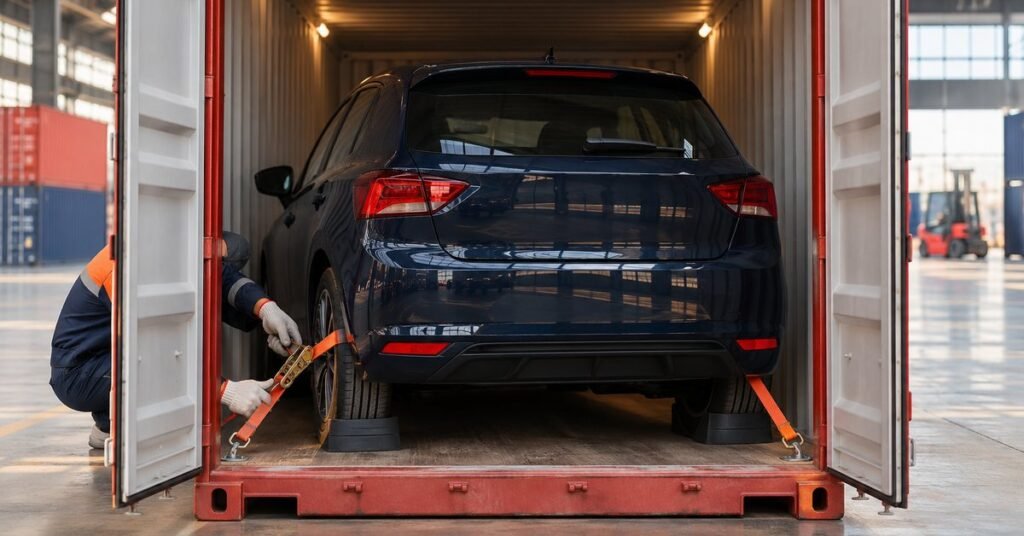
The freight quote is only one line in the cost of moving a car from Dubai to the UK. The full bill also includes UAE export paperwork, marine insurance, UK port handling, 10% import duty and 20% import VAT (unless you qualify for relief), vehicle approval, registration and vehicle tax. Unless relief applies, duty and VAT alone add about 32% of the car’s customs value, so the car’s value usually shapes the total more than the shipping method does.
This guide breaks the cost into the lines you will actually pay, shows how the UK charges are calculated with a worked example, and explains when Transfer of Residence relief removes duty and VAT altogether. If you already know the car and the move date, our Dubai to UK car shipping service can quote the freight and handling side for your exact route.
The cost lines between a Dubai garage and a UK road
| Stage | What you pay for | Who sets the price |
|---|---|---|
| UAE side | RTA export certificate, collection from your address, export customs, terminal handling | RTA fee plus shipper’s quote |
| Freight | Air freight, dedicated container, shared container or RoRo | Shipper’s quote |
| Insurance | Marine cargo insurance for the car’s value | Insurer, usually arranged with the shipment |
| UK arrival | Port or airport handling, customs clearance, the NOVA notification | Agent’s quote |
| Duty and VAT | 10% duty and 20% VAT, or nothing under Transfer of Residence | HMRC (statutory) |
| Approval | IVA test and the conversion work, or an MOT for older cars | DVSA fees plus workshop prices |
| Registration | DVLA first registration, vehicle tax, number plates, UK insurance | DVLA (statutory), plate supplier and your insurer |
The statutory lines are the same whichever company ships the car. The commercial lines vary with the method, the car and how much of the journey you want handled for you.
How UK import duty and VAT are worked out
HMRC charges import duty on the car’s customs value, which is the price paid (or its value) plus the freight and insurance up to the point the car enters the UK. The UK Trade Tariff sets duty on passenger cars at 10% for countries without a trade deal, and the UAE has none in force with the UK.
The duty rate follows where the car was made, not where you bought it. HMRC’s rules of origin guidance only keeps a preferential rate for goods that stay under customs supervision in transit. A Japanese or German car that has been registered and driven in the UAE has left that supervision, so in practice it pays 10%. Ask a UK customs agent to confirm if your car is a special case, such as a new car that never left a free zone.
Import VAT is 20% of the customs value plus the duty. Because VAT is charged on top of the duty, the two together come to 32% of the customs value (1.10 x 1.20 = 1.32). Our car import duty calculator runs the same sums for your car.
Cars at least 30 years old and still in original condition can be treated as historic collectors’ items. They pay no duty and VAT is charged on a quarter of the value, an effective 5% rate, as HMRC explains in its import VAT valuation guidance. HMRC suggests checking the classification before you buy.

A worked example (hypothetical figures)
The car value, freight and insurance below are illustrative numbers chosen to show the arithmetic. They are not an Opera Shipping quotation.
| Line | Basis | Amount |
|---|---|---|
| Car value | Invoice or valuation | £30,000 |
| Sea freight to a UK port | Illustrative freight figure | £1,500 |
| Marine insurance | Illustrative premium | £300 |
| Customs value | Car + freight + insurance | £31,800 |
| Import duty | 10% of £31,800 | £3,180 |
| Import VAT | 20% of (£31,800 + £3,180) | £6,996 |
| Duty and VAT together | £10,176 |
In this example the UK taxes are more than six times the freight line. The same car moved under Transfer of Residence relief pays £0 duty and £0 VAT. As a qualifying historic vehicle it would pay no duty and £1,590 VAT.
After that come the road-legal costs: the IVA test or MOT, any conversion work, the £55 DVLA fee, vehicle tax, plates and insurance. Those are covered below.
Transfer of Residence: when duty and VAT fall to zero
If you are moving your main home to the UK, Transfer of Residence relief can remove both duty and VAT. HMRC’s conditions include:
- you have lived outside the UK for at least 12 consecutive months;
- you have had the car in your possession for at least 6 months before the move;
- you import it within 12 months of moving;
- you do not lend, hire out, sell or use the car as security for 12 months after import;
- HMRC approves your ToR01 application before you claim the relief.
Apply before the car ships, not after it lands. Even with relief, HMRC must still be notified through NOVA within 14 days of the car arriving, and DVLA will not register it until that is done.
Approval, registration and vehicle tax
A car built to GCC specification will rarely have a European Certificate of Conformity, because that certificate confirms the car was built to an approved European type. Cars under 10 years old therefore normally need an Individual Vehicle Approval test. The DVSA fee is £199 in working hours, with £40 for a retest. The bigger cost is usually the work to pass it: a speedometer that reads in mph, headlamps that dip to the left, and a rear fog lamp, all of which DVSA lists in its guide to getting an IVA pass.
Cars over 10 years old are exempt from vehicle approval but still need an MOT, which is capped at £54.85. The lamp changes usually still apply.
DVLA then charges a £55 first registration fee plus the first vehicle tax. A used import that was registered abroad more than six months earlier and has covered more than 6,000 km avoids the higher first-year rate under the Vehicle Excise and Registration Act. Depending on whether its approval records a CO2 figure, it is taxed either at the standard rate, plus the expensive car supplement if the list price was over £40,000 (£50,000 for a zero-emission car) and the car is under six years old, or at a rate set by engine size. Rates change every April, so check the current vehicle tax tables and ask DVLA how your car will be classed before you budget.
Our guide to importing a car from Dubai to the UK walks through the NOVA, IVA and DVLA steps in order, and our guide to registering a UAE car in the UK explains when a COC works and what an IVA involves.
What changes the freight price
The commercial side of the bill depends on four choices.
Method. Air freight is the fastest and usually the most expensive per car. A dedicated container keeps the car enclosed and separate from other cargo. A shared container splits the container cost with other cars, and RoRo suits a standard running car where the timing works. Our comparison of RoRo and container shipping sets out the trade-offs.
The car. Size, weight, ground clearance and value affect loading, equipment and insurance.
Scope. Collection from your home in Dubai, delivery to your UK address and handling of the UK clearance each add a line, and each removes a job you would otherwise arrange yourself.
Routing. Since early 2026, disruption to shipping through the Strait of Hormuz has cut traffic at Jebel Ali sharply, with cargo moved by road to east-coast ports such as Fujairah and Khor Fakkan, according to Marine Insight. Sea routing and surcharges are changing more often than usual, so a quote should state the departure port, the route and how long the price holds.
What to send for a quote
Send the make, model and year, the car’s value, where it is in the UAE, the UK delivery postcode and the date you need it there. Tell us whether you expect to claim Transfer of Residence relief and whether the car is financed. With those details, our car shipping quote form gives us enough to set out the freight, insurance and handling lines, so you can add the UK taxes above and see the full cost before you commit.