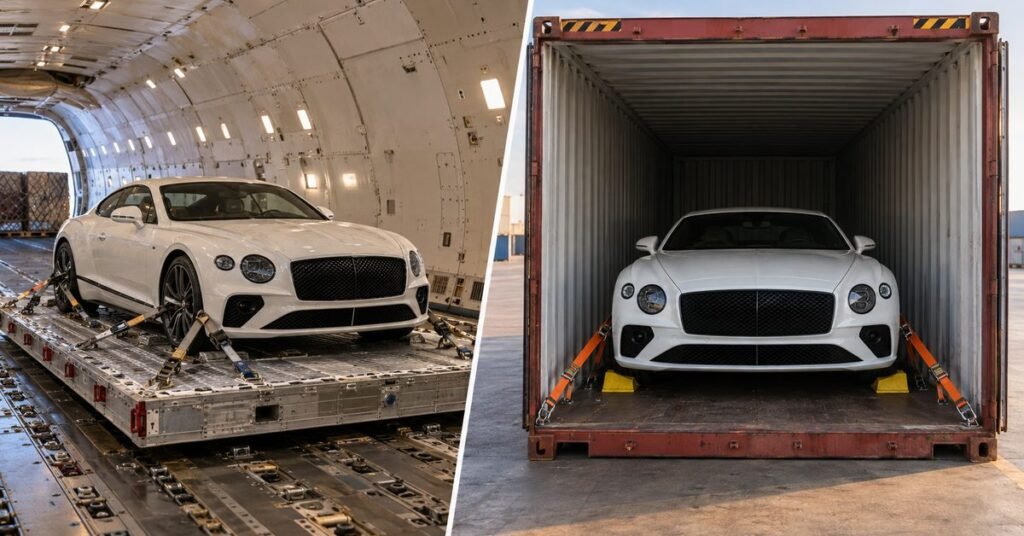
Air freight is the first option to assess when your luxury car needs to reach another country on a tight schedule. A dedicated enclosed sea container is a practical alternative when the route works and you have more flexibility. The right decision depends on the whole journey: collection, preparation, loading, transit, clearance and final handover.
For a Ferrari, Lamborghini, Rolls-Royce or another valued vehicle, comparing only a flight with a sailing leaves out much of the work that affects the experience. You need a plan for the car before it departs and after it arrives.
Opera Shipping’s luxury and exotic car shipping service takes an air-led approach. Here is how to assess that option against a sole-use container without reducing the choice to a simple speed-versus-price slogan.
Start with the date you need the car
Write down the date and place where the vehicle must be ready for handover. Then ask for the proposed collection date, departure, arrival and destination arrangements to be worked backwards from that requirement.
A flight duration is not a door-to-door delivery estimate. A fast international leg can still be followed by a wait for documents, clearance, the receiving party or local delivery. Equally, a sea proposal needs to explain more than the time between ports.
When comparing quotations, ask each provider to use the same finishing point. ‘At the airport’, ‘released from cargo’ and ‘delivered to your address’ describe different stages. A clear finishing point makes the timing comparison meaningful.
If the vehicle is needed for a particular event, relocation or onward journey, tell the coordinator what happens if that date is missed. This helps distinguish a preference from a genuine constraint.
When air freight deserves priority
Assess air freight car shipping from Dubai first when a shorter international transit is important, the car is needed on a defined schedule, or the owner wants to minimise the period spent away from the vehicle.
The next question is whether a suitable air movement is available for the actual car. Provide its model, dimensions, running condition and powertrain, together with any modifications. A vehicle’s value does not by itself establish that it can travel on the proposed service.
IATA’s dangerous-goods guidance explains that classification, preparation and documentation affect air-cargo acceptance. For a vehicle, obtain the applicable requirements through the shipping provider before preparing it for collection. The booked carrier and vehicle specification matter more than a general checklist copied from another shipment.
Ask for the handling arrangements at both ends as well. Air transport is one part of the plan; it does not automatically establish how every road transfer, waiting period or handover will be managed.
When a dedicated enclosed container is worth considering
A sole-use container may suit an owner with a flexible delivery date who wants the vehicle transported by sea in its own enclosed space. It should be assessed against the exact route, sailing availability and origin and destination arrangements.
Confirm that the proposal is genuinely for one vehicle in a dedicated container if that is what you want. Shared-container shipping is a different arrangement. Do not assume a general reference to ‘container shipping’ answers the question.
The IMO, ILO and UNECE CTU Code addresses packing and securing cargo throughout sea and land transport. That gives the buyer a useful question: who is responsible for loading, securing and unpacking the vehicle? The enclosure alone does not describe the preparation inside it.
Opera’s dedicated container car shipping service is the relevant alternative to discuss when you are comparing a sole-use sea movement with air freight. Ask for the complete handling and destination scope rather than assuming both quotations include identical work.
Compare the handovers as carefully as the transport method
Ask the provider to describe the journey from the first collection to the final recipient. For each stage, establish who has the car, what they are responsible for and how completion is recorded.
Four checkpoints make the discussion easier:
- Collection: who inspects the car, records its condition and accepts the keys?
- Loading: who confirms the vehicle-specific approach and any relevant restrictions?
- Arrival: who receives the shipment and manages the next release or clearance step?
- Delivery: who inspects the vehicle with the recipient and records the handover?
This is a buyer’s comparison framework, not a claim that one method always has fewer handling events. The answer depends on the actual route and service arrangement.
For a low-clearance car, ask how the proposed loading approach accounts for its clearance and any fitted bodywork. If an enclosed road vehicle or indoor waiting area is important, ask where that provision begins and ends. Broad wording such as ‘protected throughout’ needs an explanation of the specific stages.
Match the insurance discussion to the whole journey
Compare the cover proposed for collection, storage, loading, international transit and delivery. Ask whether any stage falls outside it and request the insured value, excess and relevant exclusions.
An ‘all risks’ label should lead to the policy wording, not end the conversation. Chubb’s cargo product disclosure, for example, refers to policy limits, deductibles and exclusions. It is an illustration of why the details matter, not a description of Opera’s insurance provider or your eventual policy.
The comparison should use the same intended level of protection. A lower quotation with different insurance or excluded local transport does not establish that the shipping method itself is better value.
Two situations that lead to different decisions
Consider an owner relocating with a fixed handover date. If a suitable air option can meet the required sequence of collection, acceptance and destination arrangements, its shorter international leg may justify choosing it. The decision should still be based on the quoted plan rather than an assumption of immediate release after landing.
Now consider an owner who does not need the car for several weeks and has suitable arrangements at both ends. A dedicated container may deserve closer consideration. Its value depends on the available sailing, loading plan and complete destination scope, not simply a lower sea-freight line item.
These are hypothetical decision examples. Neither establishes a standard transit time or a promised outcome for your shipment.
Questions to settle before booking
Before choosing air or sea, confirm the actual vehicle and route, the final handover point and date, the collection and loading arrangements, the paperwork responsibilities, the insurance offered and the charges excluded from the quote.
If any answer is still unknown, identify who will resolve it and whether it affects the booking. A clear open question is easier to manage before the car moves than after it has reached a terminal.
To compare the options with Opera Shipping, request a quote for your luxury car’s route and include the model, powertrain and required delivery date. We can assess the air-freight option and discuss a dedicated container where appropriate, with the collection and destination requirements included in the conversation.