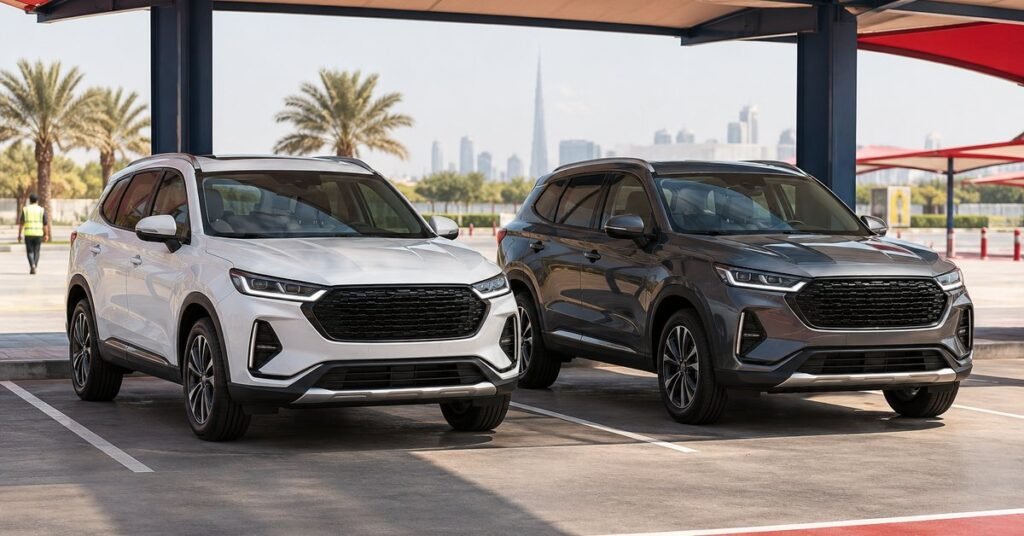
A GCC-spec car was certified for sale in the Gulf, while an American-spec car was built for the US market and later brought to the UAE. The differences that matter most to a buyer come down to three things: manufacturer warranty, how the car was prepared for Gulf conditions, and the car’s history before it arrived. American imports can be registered in the UAE once they pass conformity checks. The spec also decides how easily you can take the car abroad later, which matters if you might leave the UAE.
This guide explains what GCC spec legally means, where the two versions differ, how to check which one you are looking at, and what the choice means if you later ship the car to Europe, the UK, the USA or Canada.
What “GCC spec” actually means
GCC stands for the Gulf Cooperation Council: the UAE, Saudi Arabia, Kuwait, Qatar, Bahrain and Oman. A GCC-spec car carries a conformity certificate from the GCC Standardization Organization (GSO), which has run a unified certification scheme for new vehicles since 2005. Manufacturers certify each model against a published list of Gulf technical regulations, which includes standards for engine radiators and general vehicle requirements.
An American-spec car was certified by its maker to US federal standards instead. It is not automatically unsafe or unsuitable. It was simply approved against a different rulebook for a different climate and market. To register one in the UAE, the car must pass the UAE’s own conformity checks. When Dubai’s RTA registers a vehicle for the first time, it asks for a Ministry of Industry and Advanced Technology (MoIAT) document proving Gulf-spec compliance if the customs card does not already show it.
Where the two versions differ
| Point | GCC spec | American spec in the UAE |
|---|---|---|
| Certification | GSO conformity certificate for the Gulf | US federal certification; UAE conformity check needed to register |
| Climate preparation | Certified against Gulf standards, including radiator standards | Built for US conditions; Hyundai’s regional site says grey imports may lack local cooling and protection adaptations |
| Manufacturer warranty | Usually supported by the local dealer network | May not be honoured by the local agent (see below) |
| Speedometer | Set up for the regional market | US rules require mph; km/h may be shown as well |
| Import history | Built for sale in the Gulf | Arrived used, so its history in the US matters |
| Resale in the UAE | The spec local buyers and dealers know | Buyers may price in warranty and history risk |
Some of the climate claims you will read about American imports come from insurers and dealers rather than manufacturers, so treat sweeping statements with care. The clearest manufacturer statement comes from Hyundai’s Middle East site (its Bahrain page), which says grey-market cars may lack enhanced cooling systems and specialised protection and may not be compatible with local fuel, emissions or software standards.
Dealers in the region commonly describe GCC versions as having a larger radiator, a stronger air conditioning system, extra dust filtration and added rust protection. The exact changes vary by model and year, and some US versions already have similar hardware, so ask the manufacturer’s local agent what was changed for the car you are looking at. It is also worth asking your insurer before you buy, because some UAE insurers ask about the spec and may quote an imported car differently.

Warranty is usually the biggest difference
For many buyers the warranty matters more than the radiator. Toyota’s US warranty booklet, for example, covers cars originally sold by an authorised US dealer and operated in the US, its territories or Canada, and warns that a local distributor elsewhere may have no obligation to provide warranty service. Hyundai’s regional site says grey-market cars may not be eligible for warranty or service support except where local law requires it, and GM’s official GMC dealer for Dubai and the Northern Emirates says imported vehicles may not qualify for GM’s manufacturer warranty in the UAE.
Before you pay for an American-spec car that is still within its factory warranty period, ask the local agent in writing whether they will honour it for that VIN.
History: check what happened in the US
An American import has a life before the UAE. The UAE bans the import, licensing and insuring of seven categories of used vehicle, including burnt, flooded, scrapped and damaged-beyond-repair cars and those with major manufacturing defects, under rules MoIAT dates to 2017. That does not mean every car with a past repair was stopped at the border, so do your own checks.
In the US, insurers and salvage yards must report total-loss vehicles to the federal NMVTIS database. Reports are sold through NMVTIS-approved providers. A report costs little compared with buying a car that was written off.
How to check which spec a car is
- Ask for the customs papers. Dubai Customs’ vehicle clearance data includes a GCC or non-GCC specification field, and the RTA customs card shows whether it is Gulf compliant.
- Use GSO’s VIN lookup. GSO’s Verify VIN Details page shows whether a GCC conformity certificate is linked to the VIN. A blank result is a question to raise with the seller, not proof either way, because coverage of older cars may be incomplete. You can also run the number through our free VIN and chassis number check, which decodes it and links to these official checks.
- Read the VIN carefully. The first three characters identify the manufacturer and where the car was built, not which market it was built for. A GCC-spec car can be built in the US. On a US-market car, the tenth character is the model year.
- Look at the door frame. A US-market car carries a US certification label stating it conforms to US standards.
Our separate guide on how to identify a GCC spec car goes through these checks step by step.
What the spec means when you export the car
If you might leave the UAE, the spec matters as much as the price. Each destination treats a GCC-spec car differently:
- USA: a car under 25 years old must have been certified to US standards. A GCC-spec car can only enter through a Registered Importer, only for eligible models, and its emissions must be certified by an EPA Independent Commercial Importer. An American-spec car with its original labels is far simpler. Our guide to shipping a car from Dubai to the USA covers both routes.
- Canada: a car built to another country’s standards cannot be imported until it is 15 years old, with no conversion route. See our guide to shipping a car from Dubai to Canada.
- UK: a GCC car under 10 years old normally needs an Individual Vehicle Approval test, with changes such as an mph speedometer and left-dipping headlamps, as our guide to registering a UAE car in the UK explains.
- EU: registration rules vary by country, and a car built for the Gulf market may need an individual approval. Our guide to importing a car from Dubai to Europe covers the main markets.
So an American-spec car can be the easier car to take to the USA (and, for people moving to or back to Canada, to Canada), and a GCC-spec car the easier one to sell or keep in the region.
A quick checklist before you buy
- Confirm the spec from the customs card or clearance certificate, not the advert.
- Run the VIN through GSO’s lookup and a US history report if it came from the US.
- Ask the local agent in writing whether the factory warranty applies.
- Think about where you will be in three to five years, and whether the car can go with you.
If you are buying in the UAE to export, or importing an American car into Dubai, send us the make, model, year and specification through our shipping quote form. We will tell you what the destination will ask for before you commit to the car or the freight. Our car import service and car export service cover both directions.