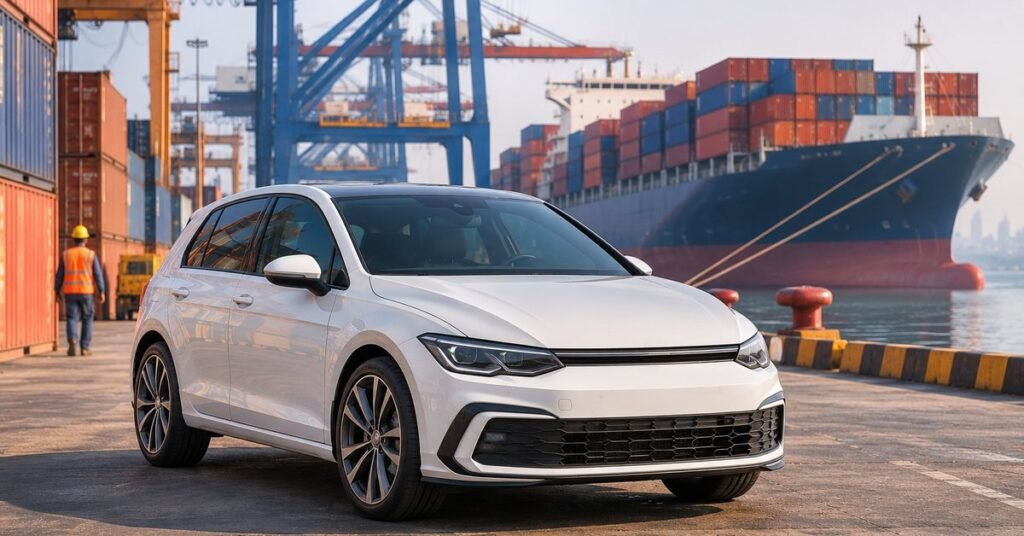
For most cars registered in Dubai, the honest answer is no, or not at a cost that makes sense. Apart from vintage cars, India’s import policy only allows a used car in if it is no more than three years old, right-hand drive, with a speedometer in kilometres and headlamps set for driving on the left. Almost all cars sold new in the UAE are left-hand drive. If you are moving back to India after at least two years abroad and have had the car abroad for at least a year, the age and steering conditions do not apply, but full customs duty still applies, and on most used cars duty and IGST together come to well over twice the car’s value.
This guide explains the rules, works through the duty with an example, and covers the transfer of residence route for NRIs, so you can decide whether to ship the car or sell it in the UAE before you move.
The rules for importing a used car into India
Cars are freely importable into India without a licence, but used cars must meet Policy Condition 1 of Chapter 87 of India’s import policy. As quoted in a CESTAT tribunal order that reproduces the policy, a used car must:
- be no more than three years old from its date of manufacture;
- have right-hand steering and controls;
- have a speedometer that reads in kilometres;
- have headlamps suited to keep-left traffic;
- meet the Motor Vehicles Act, 1988.
The notification that set these rules also required used cars to come in only through the customs port at Mumbai, to be tested before shipment, and to be tested again on arrival by an approved agency such as ARAI in Pune or VRDE in Ahmednagar. Check the current port and testing requirements with a customs broker before shipping, because the published text is old.
For a typical UAE car, the right-hand drive condition alone ends the question.
Moving back to India: the transfer of residence route
If you are moving to India permanently after at least two years of continuous stay abroad, the policy’s age and right-hand drive conditions do not apply, provided the car has been in your possession abroad for at least one year. The CESTAT order quotes the exception as applying “on payment of full customs duty”.
Three points matter:
- It is not duty-free. India’s Baggage Rules 2026 give returning residents an allowance for personal and household goods, but cars are not part of it. The car pays the full rate.
- Ownership is checked. In the CESTAT case above, a returning resident shipped a right-hand drive car bought in the UAE that he had owned for about two months, not the required year. The car was confiscated and released only on a redemption fine, and penalties of ₹2 lakh and ₹3 lakh were imposed.
- Registration is a separate hurdle. Even where the policy conditions are waived, registering a left-hand drive car for Indian roads is a practical obstacle. Get written advice from a customs broker before shipping a left-hand drive car under this route.

How much duty you would pay
India’s Budget 2025-26 changes restructured car duty without changing the effective customs rate. Used cars pay 70% basic customs duty plus a 67.5% Agriculture Infrastructure and Development Cess (AIDC), with no social welfare surcharge. IGST is then charged on the value plus those duties. Under the GST changes, larger cars and SUVs pay 40% IGST and small cars 18%.
The calculation for a used car in the 40% IGST bracket:
| Step | Rate | Share of assessable value |
|---|---|---|
| Basic customs duty | 70% | 70% |
| Agriculture infrastructure cess | 67.5% | 67.5% |
| Customs subtotal | 137.5% | |
| IGST base (value + customs) | 237.5% | |
| IGST at 40% | 40% of 237.5% | 95% |
| Total tax | 232.5% of the value |
Worked example (hypothetical). A used SUV with an assessable value of ₹40 lakh would pay about ₹93 lakh in duty and IGST, so its duty-paid cost would be about ₹1.33 crore before port charges, testing, broker fees and state road tax. A small car in the 18% IGST bracket would pay about 180% of its value in the same way.
Rates can change in any Union Budget or GST Council decision, so ask a customs broker to confirm the figures for your car before you commit. Our car import duty calculator shows the same calculation for your car’s value.
Registering the car in India
After clearance, the car is registered at the state RTO on Form 20, with Form 22 for roadworthiness, insurance and the customs clearance certificate for an imported vehicle, under the Central Motor Vehicles Rules. Imported cars may also need testing and certification by an approved agency such as ARAI or ICAT. State road tax is charged on top of the customs duty.
Is it worth shipping a car from Dubai to India?
For most owners, the numbers point the same way. A left-hand drive car usually cannot qualify, and a car that does qualify pays more in duty and IGST than it is worth. The more practical options are:
- sell the car in the UAE before you move and buy in India;
- keep the car in the UAE if you expect to return, using an RTA possession certificate while it is off the road;
- ship it only if it meets the rules, for example a qualifying right-hand drive car under the transfer of residence route, and only after a broker has confirmed the duty in writing.
If you are moving elsewhere instead, such as to the UK, Europe, the USA or Canada, the rules and costs are very different. Our guides to importing a car from Dubai to the UK and to Europe explain those routes.
Ask us before you decide
If you are unsure whether your car qualifies, a licensed Indian customs broker is the right first contact, and should confirm the duty in writing before anything is booked. If you are moving to the UK, Europe, the USA or Canada instead, send the make, model, year and destination through our car shipping quote form and see our UAE car export service.